My understanding of idealism is that there is no world out there beyond our experiences. Only our experiences are real. I plump for the orthodox common sense point of view of realism, that there is a real world out there unless I am provided with a good reason to think otherwise. To me if you keep strictly to the point of view that nothing exists beyond experience then as far as I’m concerned only my experience exists and the experiences of you lot do not exist. In other words it seems to me strict idealism implies solipsism. Then I’d really be talking to myself. However, Berkeley I believe if I remember right from the Open University philosophy course I undertook, introduces the notion of this God, a concept that you might have heard of, consisting of a supreme mind or conscious experience which ties all our experiences together, perhaps because our experiences are all part of his experience. This means strictly speaking there is something out there beyond my own personal experience even if only it is the rest of God’s mind.
Berkeley applies Occam’s Razor to cut out the world out there. The external real world is an unnecessary entity that need not be postulated because it doesn’t explain anything. (I am not referring to any text of Berkeley’s; I am just going by what I remember was said about him in the OU course I took.) But I think it does explain something, which is the nature of our experiences. Why not apply Occam’s Razor to the God concept instead? (Ockham would not approve of this. As far he was concerned the razor should be applied to all those gods besides the Christian God. However , as Richard Dawkins (our lord and master) once said:
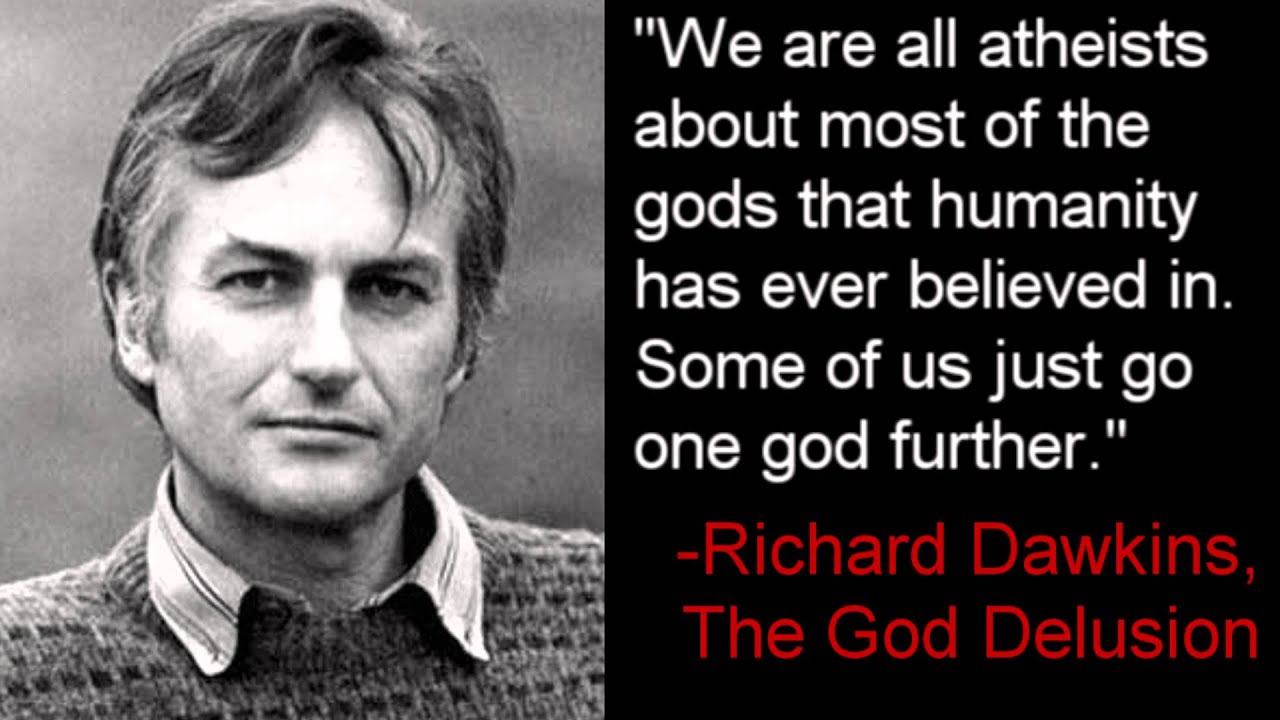
Or to put it another way:

However, one could respond by saying that the nature of our experiences is explained by God rather than the real world. Thus you have God to explain all our experiences and thus we do not need the external world to explain them.
The illusion of an external world could be the doing of the supreme mind. But why would God create this illusion? Perhaps it makes our existence more enjoyable. He may also be providing us with a vale of tears for us to develop some moral fibre. Perhaps. One objection is that some people’s experiences are so horrible (e.g.torture, being buried alive, being burned alive) that one would expect God to intervene as such experiences do not usually develop good moral character but instead damage people’s minds, which means they find themselves unable to contribute positively to their experiences (if their experience is not either terminated or converted to one of blissful existence). The Christian may respond with the free will defence. Divine intervention may interfere with the free will of those causing suffering. But some suffering is not caused by other people (earthquakes, volcanoes). In any case God could uncouple the effect on a possible victim’s experience from the experience of a would-be oppressor. A Nazi officer may think he is causing suffering to one of his concentration camp inmates but these inmates need not be real people. Perhaps it would then all get too complicated. Even so, I would argue that preventing horrific suffering takes priority or precedence over the Nazi officer’s free will. A policeman could not argue that he decided not to save a victim from a crime on the grounds that it would interfere with the criminal’s right to self-determination. Still, maybe the Christian can offer other defences for the problem of evil so let us suppose there is some good reason for horrific suffering, although this does mean postulating entities that need not exist if we postulated just a real world instead.
Another thing is that this talk of a mind that is supreme no less smells of the human desire to impress. There seems to be no reason why reality should reflect human desires and wishes, in particular the desire that there is this big boss who makes all the rules which you ought to obey or else. Why not just a network of interlinked minds with diverse levels of control over the experiences of others? But we’ll leave this aside as well.
There is also the question of how this divine mind works. When God wills for example that another mind’s experience contains certain features, how is the causal link established? It seems that some sort of mechanism needs to be postulated to explain these causal links. Otherwise there would be no reason why the big boss mind could count on these causal links to have the expected effect. What guarantees that God’s control will continue for eternity? The idealist could reply by saying that at bottom we don’t know the ultimate mechanisms responsible for establishing causal links in an external real world. So then we do not have extra unknown mechanisms to postulate in the idealist scenario because the realist scenario possesses such extra unknown mechanisms too. However, in the external world as we experience it there is clearly some complicated machinery in place which establishes the causal links between our desires and getting what we want. There are things like nerves, muscles etc not to mention all the paraphernalia outside our bodies. These ultimately break down in terms of simple or at least simpler relations between particles of matter. But in the idealist scenario we must somehow explain how, for example the desires of God or even those of his peasant children, translate into actual effects. We cannot appeal to any complicated machinery like nerves, muscles etc. because nothing outside of our experiences is supposed to exist. So what makes our experiences conform to certain rules? Saying that God does indicates a failure to understand properly my argument. For the next question then becomes: what guarantees that God’s desires will be implemented for eternity? (Experience suggests that this point can be difficult to get across to a mind that is used to thinking along certain rigid heavily trodden lines.)

No comments:
Post a Comment